The Colossus of the Oceans
Reaching lengths of over 12 meters (40 feet) and weights exceeding 20 metric tons, the whale shark (*Rhincodon typus*) is the largest living non-mammalian vertebrate on Earth. Despite its colossal dimensions, it is entirely docile and harmless to humans.
Its broad, flattened head features a mouth spanning up to 1.5 meters wide, equipped with over 300 rows of minute vestigial teeth and specialized sponge-like filter pads used to sift plankton, krill, and micro-crustaceans.
Baja California Sur Plankton Nurseries
Between October and April, prevailing northern winds drive coastal upwelling in the Bay of La Paz and along the coastline of Los Cabos, creating dense blooms of phytoplankton and zooplankton.
Juvenile whale sharks gather in large numbers in these sheltered, nutrient-rich shallow bays, basking near the surface as they slowly cruise with their mouths open in active ram-filtration feeding.
Unique Spotting Patterns: Ocean Fingerprints
The striking pattern of white spots and vertical stripes adorning each whale shark's slate-blue back is unique to every individual, much like human fingerprints.
Marine biologists and citizen scientists photograph the area behind the gill slits, using satellite star-mapping algorithms to identify, catalog, and track individual sharks across trans-Pacific migration corridors.
World-Leading Ecotourism Protocol
Baja California Sur enforces one of the most advanced eco-sanctuary frameworks globally. Satellite-tracked entry permits limit the number of active boats, and mandatory onboard certified guides ensure swimmers never touch or impede the shark.
Swimmers must remain at least 2 meters from the body and 3 meters from the tail fin, completely prohibiting flash photography and underwater motorized scooters.
Galería de Whale Shark en Los Cabos y BCS
 Nado Pelágico
Ejemplar adulto nadando pacíficamente en aguas abiertas acompañado de rémoras
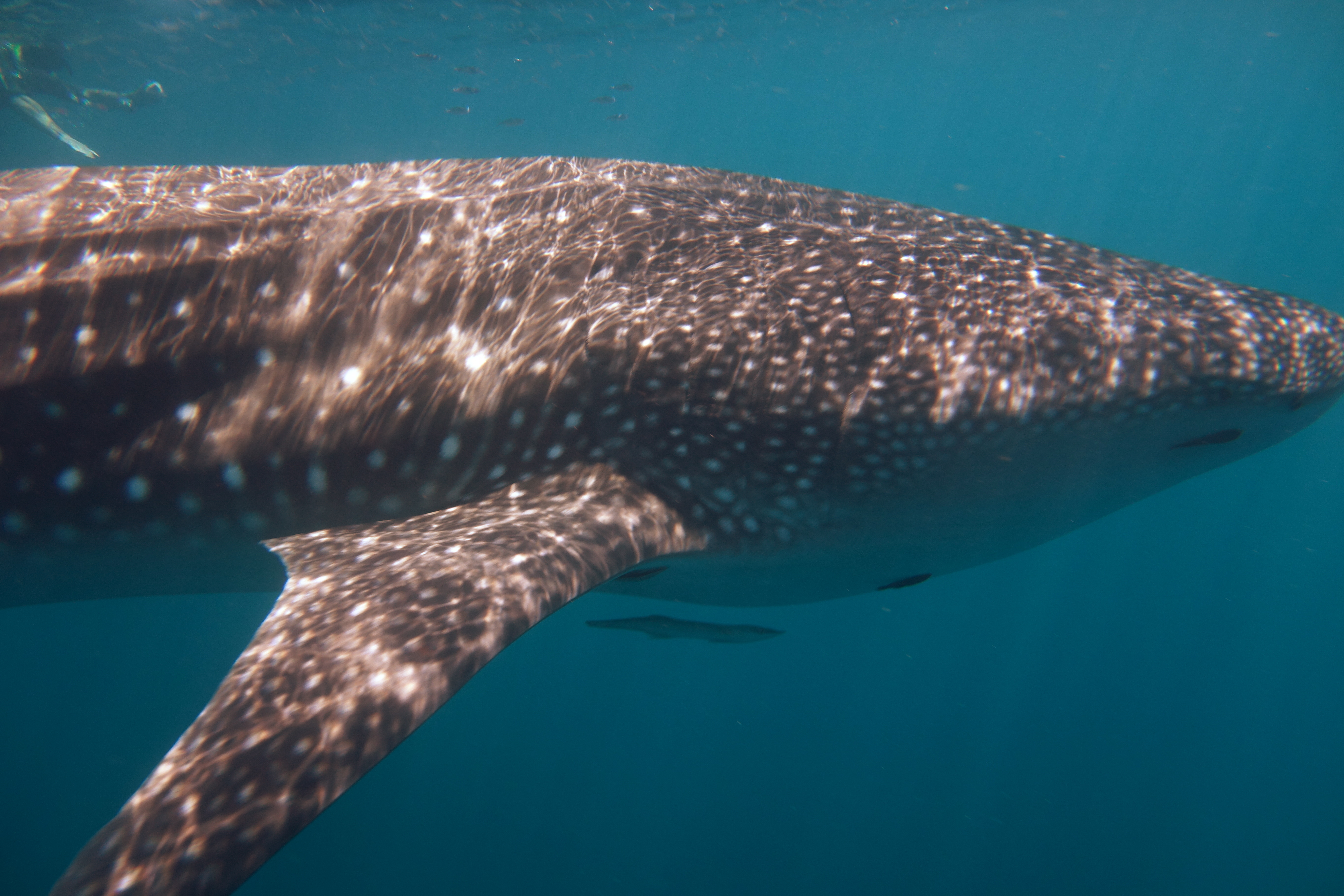 Morfología y Manchas
Patrón estelar de manchas y líneas blancas en la aleta dorsal bajo reflejos de luz solar
¿Deseas avistar a Whale Shark en persona?
Explora el directorio de capitanes certificados, biólogos marinos y escuelas de buceo con autorización oficial en Cabo San Lucas, San José del Cabo y Cabo Pulmo.
Fuentes Oficiales y Bibliografía Verificada
- Comisión Nacional de Áreas Naturales Protegidas (CONANP)
- Proyecto Tiburón Ballena México
- Unión Internacional para la Conservación de la Naturaleza (UICN)
- Programa de Manejo de Tiburón Ballena en Bahía de La Paz
Ficha biológica verificada para la Enciclopedia de Baja California Sur. Si eres biólogo o prestador certificado y deseas aportar observaciones de campo, contacta a nuestro equipo científico.